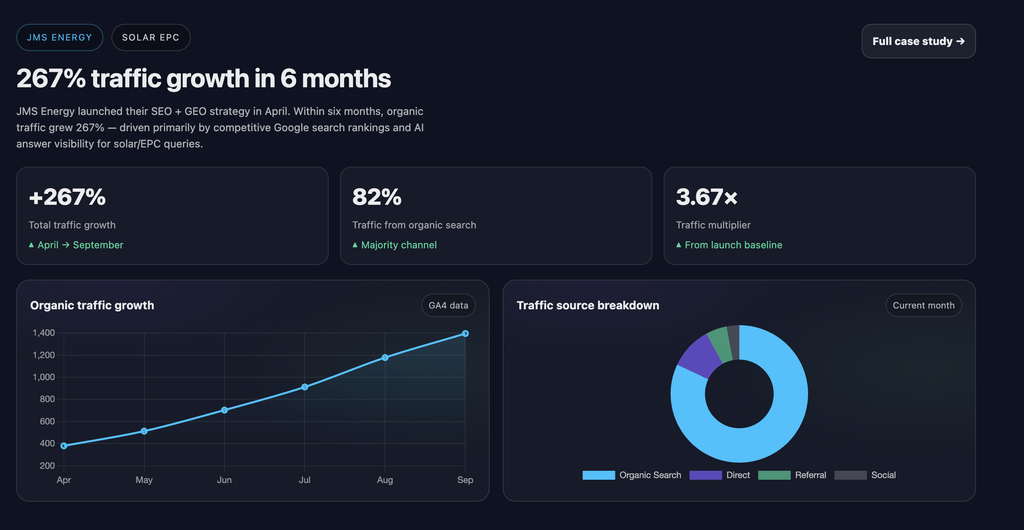
JMS Energy’s website traffic grew 267% in six months, from about 380 sessions a month to about 1,395. Organic search went from 41% of that traffic to 82%. The renewable energy SEO work behind it built out pages for each service, added structured data, and answered buyers’ questions directly on the page, a format that works in Google and in AI tools like ChatGPT.
Table of Contents
JMS Energy: results at a glance
- +267% monthly sessions (about 380 → 1,395)
- 41% → 82% of traffic from organic search
- 12 → 58 ranking keywords (+383%)
- 1.8% → 4.6% click-through rate from Google (+156%)
- 6 → 28 pages indexed in Google
Timeline: April to September 2024. Sources: Google Analytics (sessions, channel share), Semrush (keywords), and Google Search Console (click-through rate, indexed pages). The full data is on our Marketing KY results page.
Who is JMS Energy?
JMS Energy is a renewable energy company. Their work includes large-scale wind energy services and engineering, procurement, and construction (EPC) for solar projects. We designed and built their website; you can see it on our portfolio.
What was holding them back in search?
Energy buyers research for months before they reach out. Developers, landowners, and utilities compare contractors, read about capabilities, and look for proof of experience. When the SEO work started in April, JMS Energy’s site had only six pages in Google’s index and ranked for 12 keywords. Competitors were picking up the searches JMS should have been winning.
- Services were covered on too few pages, so there was little for Google to rank.
- The site had few pages aimed at decision-stage searches from buyers ready to hire.
- Structured data was limited, so Google and AI tools had less to go on about who JMS is and what they do.
- Internal linking was inconsistent.
What did we do?
Technical foundation. We cleaned up crawling and indexing, improved speed, and added structured data (Organization, Service, FAQ, and Article schema) so search engines can clearly identify JMS Energy and its services.
A page for every core service. We built pillar pages for each main service, then supporting pages around the questions buyers ask, all linked together so each topic reinforces the others.
Answer-first content. On key pages, we added short question-and-answer sections that answer common buyer questions in the first sentence or two. That format earns clicks in Google and gives AI tools like ChatGPT and Google’s AI Overviews a clear answer to cite. We explain the approach in how to get your business into AI Overviews.
Local and service-area targeting. We set up local SEO so JMS shows up for searches in the areas it serves.
Clearer next steps. We tightened calls to action and simplified the inquiry path so interested buyers can reach JMS easily.
What changed?
In six months, monthly sessions grew from about 380 to about 1,395. Organic search now brings in 82% of the site’s traffic, up from 41%, which means growth came from people actively searching for what JMS offers.
Ranking keywords grew from 12 to 58, and indexed pages from 6 to 28, so the site now has far more ways to be found. The click-through rate from Google more than doubled, from 1.8% to 4.6%. That’s a sign the pages are matching what searchers want: when JMS shows up, more people choose to click.
“They did a phenomenal job on our website, which was eye-catching yet professional, and we were really proud of it. It had a good flow and represented us well.” JMS Energy
What can other energy and construction companies learn from this?
Long buying cycles reward companies that are present for the whole journey. A buyer who finds a clear, credible answer from JMS early in their research is more likely to come back to JMS when they’re ready to hire. That’s why the answer-first sections mattered as much as the service pages: they put JMS in front of buyers months before a project starts, in Google and in AI answers.
Frequently asked questions
How quickly can renewable energy SEO show results?
JMS Energy saw traffic grow 267% within six months. Results depend on the starting point and competition, but a site with few pages and little content has the most room to grow quickly.
What is answer-first content?
It’s content that answers a specific question in the first sentence or two, then adds detail. It helps pages earn featured spots in Google and makes it easier for AI tools to quote your business when someone asks a related question.
Does schema markup matter for SEO?
Yes. Structured data tells search engines exactly what your business is, what services you offer, and what questions a page answers. It doesn’t guarantee rankings, but it removes guesswork for Google and AI tools.
Want to know where your business stands?
Find out whether Google and AI tools can see your business today. Our free AI Visibility Audit shows whether tools like ChatGPT mention you and who they recommend instead. Run your free AI Visibility Audit or see our SEO services.