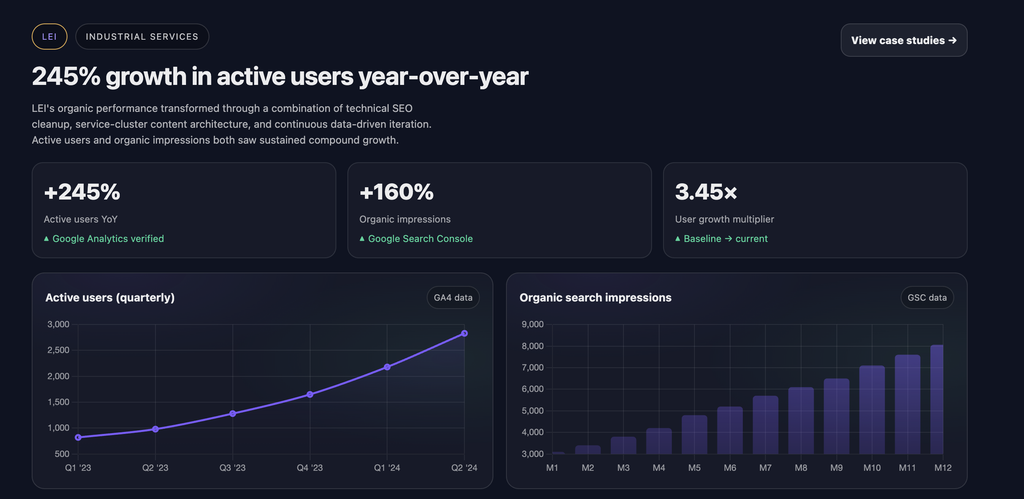
LaFayette Engineering grew its active users by 245% in a year, from about 820 a quarter to about 2,830. Conversions on its service pages rose from about 6 a month to about 22. The industrial SEO work behind it focused on three things: fixing what kept Google from reading the site, building pages around the services buyers search for, and making the site easier to move through once visitors arrived.
Table of Contents
LaFayette Engineering: results at a glance
- +245% active users, year over year (about 820 → 2,830 a quarter)
- ~6 → ~22 service page conversions a month (+267%)
- +160% monthly search impressions (about 3,100 → 8,060)
- 1:12 → 2:38 average session duration (+119%)
- 1.4 → 2.8 pages per session (+100%)
Sources: Google Analytics (users, conversions, engagement) and Google Search Console (impressions), comparing the most recent period with the same period a year earlier. The full data is on our Marketing KY results page.
Who is LaFayette Engineering?
LaFayette Engineering is a material handling company based in Danville, Kentucky, with contracts in almost all 50 states. They design and install the conveyor and automation systems that keep warehouses and distribution centers moving. They’re also the company behind Attabotics, the robotic cube storage brand whose website we redesigned and host. We designed LaFayette’s website too; you can see both on our portfolio.
What was holding the site back?
Industrial buyers do a lot of research before they call anyone. They compare capabilities, look for proof of similar projects, and check whether a company can handle work at their scale. LaFayette’s site had the expertise to win those comparisons, but it wasn’t organized to show up for them.
- Technical issues made the site harder for Google to crawl and slower for visitors to load.
- Services and capabilities weren’t broken out into their own pages, so the site had few chances to rank for specific searches.
- Navigation and internal links didn’t guide visitors from one relevant page to the next, so many left after a single page.
What did we do?
Technical cleanup first. We ran a full SEO audit, fixed crawl and indexing problems, and improved page speed. Nothing else works until Google can read the site and visitors don’t wait for it to load.
Pages built around services and capabilities. We organized the site into groups of service and capability pages, each focused on what a buyer would search for. This gives Google a clear picture of what LaFayette does and gives buyers a page that answers their exact question.
Clearer navigation and internal links. We overhauled internal linking and simplified navigation so a visitor who lands on one service page can easily find related services, past work, and a way to get in touch. That’s what doubled pages per session.
Monthly reviews. Every month we looked at what was ranking, what visitors were reading, and where they dropped off, then refreshed content based on what the data showed.
What changed?
Year over year, LaFayette’s active users more than tripled, from about 820 a quarter to about 2,830. Search impressions grew 160%, so far more buyers saw LaFayette in Google results.
The engagement numbers matter just as much. Visitors now stay more than twice as long (2:38 versus 1:12) and view twice as many pages. For an industrial company, that’s the difference between a buyer glancing at a homepage and a buyer reading through capabilities, which is why service page conversions climbed from about 6 a month to about 22.
“Tunnel Vision Design LLC communicates effectively with our team. We honestly feel like they’re part of our internal staff. They’re always available when we need them, and they deliver results within quick turnaround times.” LaFayette Engineering, Inc., in a Clutch review
What can other manufacturers learn from this?
Traffic alone isn’t the goal for an industrial company. A few hundred of the right visitors are worth more than thousands of the wrong ones. The biggest gains here came from making the site easier to understand, for Google and for buyers. When each service has its own clear page and every page leads somewhere useful, engagement rises, and conversions follow. We cover more of what industrial buyers look for in manufacturing website design.
Frequently asked questions
Does SEO work for B2B industrial companies?
Yes, and often better than for consumer businesses, because industrial buyers research heavily online before they contact a supplier. LaFayette’s service page conversions grew from about 6 to about 22 a month as more of those buyers found and explored the site.
What should an industrial company fix first?
Start with the technical basics: crawl errors, indexing, and page speed. Then make sure every major service or capability has its own page. Those two steps account for most of the early gains.
How do you measure industrial SEO results?
We track search impressions and rankings in Google Search Console, then users, engagement, and conversions in Google Analytics. Conversions matter most, because they show whether search traffic is turning into real inquiries.
Want to know where your business stands?
Find out whether Google and AI tools can see your business today. Our free AI Visibility Audit shows whether tools like ChatGPT mention you and who they recommend instead. Run your free AI Visibility Audit or see our SEO services.